FireSmart Renovation Tips for Kootenay Homes
 Legacy Build
March 17, 2026
Legacy Build
March 17, 2026
If you live in the West Kootenays, wildfire isn’t a distant concern – it’s a seasonal reality. Summers in the region have grown increasingly dry and smoke-filled, and communities near Castlegar, Christina Lake, and throughout the RDCK have watched fires burn uncomfortably close to residential areas.
The good news is that wildfire-resistant renovations are practical, increasingly affordable, and supported by local rebate programs. This guide covers what actually works, what it costs, and how to prioritise your investments.
Understanding the Home Ignition Zone
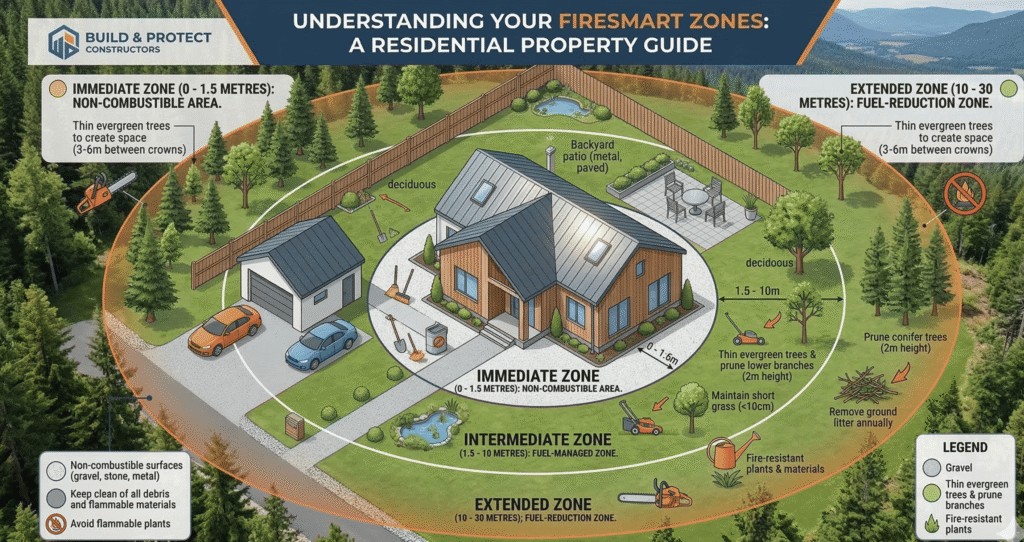
FireSmart research identifies a concept called the Home Ignition Zone – the area immediately surrounding your home that most determines whether your house survives a wildfire. It’s divided into three zones:
- Zone 1 (0–10 metres from structure): The most critical. Embers land here and ignite. Remove all combustible materials – wood piles, dry vegetation, bark mulch, propane tanks near the structure.
- Zone 2 (10–30 metres): Reduce fuel continuity. Thin trees, space shrubs, remove ladder fuels that let ground fire climb into tree canopy.
- Zone 3 (30–100 metres): Maintain general vegetation management to slow fire spread toward the home.
In the Kootenays, Zone 1 requires particular attention in late summer when grasses dry out and fire travel is fastest.
Source: FireSmart Canada – Home Ignition Zone Guide
The Highest-Impact Renovations – Prioritised by Effectiveness
Not all upgrades are equal. Here’s where to put your money first, based on ignition risk:
1. Roofing
The roof is the largest surface area exposed to ember showers. If you have cedar shakes, you have the highest priority upgrade on the list. Replace with Class A fire-rated materials:
- Metal roofing (steel or aluminum) – top rated, long lifespan, handles snow loads well
- Fibre cement or concrete tile – good fire resistance, heavier structural load
- Asphalt shingles with Class A rating – cost-effective minimum standard
2. Vents and Openings
Embers enter homes through vents – soffit vents, gable vents, and foundation vents. Upgrading to 1/16-inch mesh screening or ember-resistant vent covers is one of the highest-value, lowest-cost changes you can make. It’s estimated that ember intrusion causes the majority of home losses in wildfires.
3. Windows and Doors
Single-pane windows can fail from radiant heat before fire even reaches the house. Upgrade to double or triple-pane with tempered glass. Exterior doors should be solid-core or metal. Sliding glass doors are a known vulnerability – consider exterior shutters or upgraded glazing.
4. Deck and Exterior Siding
Wood decks adjacent to the house act as fuel. Options include:
- Composite decking with fire-resistant ratings
- Concrete or paver patios in Zone 1
- Metal deck framing instead of wood
For siding, fibre cement (James Hardie and similar) is widely used in the Kootenays for its fire resistance and durability in freeze-thaw cycles.
RDKB FireSmart Rebates – Up to $5,000 Available
The Regional District of Kootenay Boundary (RDKB) currently offers rebates of up to $5,000 for eligible FireSmart home treatments. This includes hazardous tree removal, landscape modifications, and structural improvements that meet FireSmart standards.
To access rebates, you typically need a free FireSmart Home Assessment first – a trained assessor visits your property, evaluates your risk zones, and produces a report that forms the basis for rebate applications. Book assessments directly through your local fire department or the RDKB.
Source: RDKB FireSmart Program
What Kootenay-Specific Conditions Change the Equation
FireSmart guidance is largely national, but the West Kootenays have specific factors worth noting:
- Snow loads affect roof material choices – metal roofing is ideal because it sheds both snow and embers
- The freeze-thaw cycle influences siding material longevity – fibre cement handles it better than vinyl in this climate
- Terrain matters – homes on ridgelines or in valleys with afternoon wind exposure have higher risk profiles
- Christina Lake and areas along Highway 3 have higher historical fire exposure than central Castlegar
Frequently Asked Questions
Is my Kootenay home at risk of wildfire?
Most properties in the rural and semi-rural West Kootenays carry some wildfire interface risk. The best way to assess your specific risk is to book a free FireSmart Home Assessment through the RDKB or your local fire department – it’s free, and the report gives you a prioritised action plan.
How much does a FireSmart renovation cost?
Costs vary widely depending on scope. Vent screening upgrades might cost a few hundred dollars and a weekend. A full roofing replacement to a Class A fire-rated material ranges from $15,000 to $45,000+ depending on home size and material choice. Prioritise Zone 1 and structural vulnerabilities first – you don’t have to do everything at once.
Can I claim FireSmart upgrades on my home insurance?
Some insurers in BC offer premium discounts for FireSmart-certified properties. Contact your insurer directly and ask whether they recognise FireSmart Home Partner status or specific structural upgrades. Policies vary significantly between providers.
Does a metal roof make sense for Kootenay winters?
Yes – metal roofing is well-suited to the Kootenays for multiple reasons. It sheds snow efficiently (reducing structural load), is Class A fire-rated, and has a lifespan of 40–70 years compared to 20–25 years for asphalt shingles. The higher upfront cost is typically offset over the life of the roof.